The decision, with conditions
- Choose this route when
- Choose the balanced arrangement after each seat has a reachable surface and useful light and the fixed routes stay clear, even when the two sides use different pieces.
- Use the alternative when
- Connect unmatched lamps or tables through a restrained material, shade, or proportion when identical items would create a redundant position or awkward power route.
- Stop or change the plan when
- Stop forcing symmetry when it blocks a door, leaves a lamp without a task, or gives one person a visibly coordinated but practically inferior seat.
Compare the practical options
| Symmetry problem | Function-led alternative | How to review balance |
|---|---|---|
| A matching table blocks a door | Keep the route and relocate or change the piece | Compare the full occupied room |
| One paired lamp has no useful seat | Assign separate task and ambient roles | Test source visibility from each actual position |
| Dark cabinet outweighs a smaller opposite piece | Balance with a different scaled group or clear field | Judge visual weight, not equal item counts |
| Lamp symmetry requires a crossing cable | Resolve safe power and accessible controls | Approve the evening sequence rather than the photograph |
Balance is more useful than compulsory symmetry
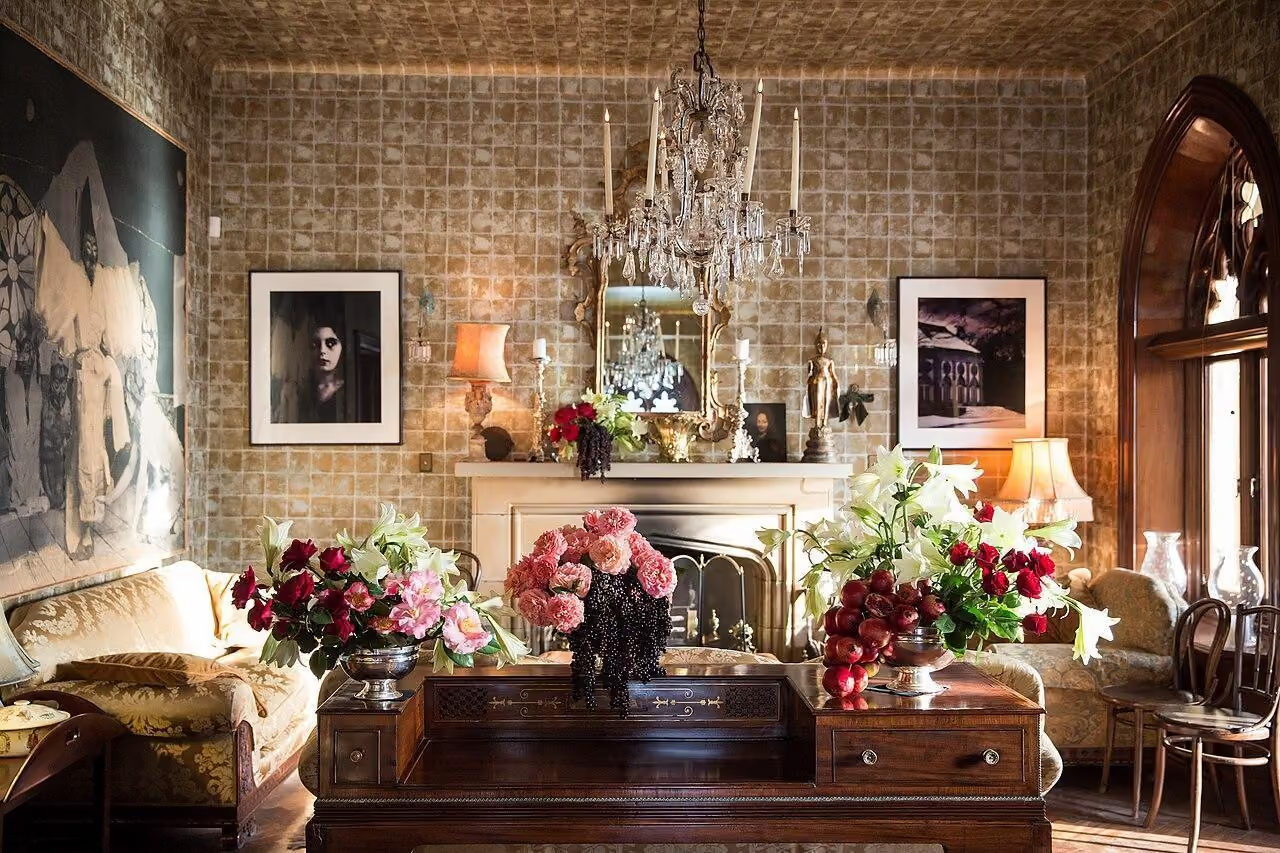
A traditional living room can feel settled through familiar furniture profiles, restrained pattern, and a balanced arrangement. A pair of shaded lamps often contributes to that sense of order. The room becomes less comfortable when symmetry is pursued so rigidly that one lamp has no useful seat, a table blocks a door, or the main route must bend around an identical furniture group. Visual balance should serve the plan rather than overrule it.
Start with the actual asymmetry of openings, activities, and fixed features. Related pieces can provide balance without equal quantities of furniture or identical functions on both sides.
Mark the features that cannot move
Draw openings, fixed heating or ventilation, built-in storage, and the normal route between rooms. Include door swings and the approach to frequently used cupboards. These are not minor interruptions to a decorative plan; they establish where furniture can work. A symmetrical arrangement that blocks one of them is incomplete even if its elevation looks graceful.
Place the main seats next, according to conversation, reading, and any screen use. Test each with a person sitting and another passing. The position of a useful side table may emerge from this trial. Let that need guide the lamp position rather than adding a table to the wrong place simply because the opposite side has one.
Give each lamp a specific task
One lamp might serve a reading chair while another provides ambient light beside a sofa. Their roles can differ even when their shades or bases are related. Test the source from the occupied position. A lamp that looks well proportioned on a table may expose a bright bulb to the person seated beside it.
For reading, check the page and the occupant's shadow. For ambient light, consider how the surrounding wall and room edge are revealed. A matching pair is useful only if both function well. If one position cannot support the same fitting, a related but different lamp may create a better balance. The traditional character can remain through proportion and material rather than strict duplication.
Compare visual weight rather than item count
Compare visual weight rather than counting pairs. A dark cabinet can balance a lighter group or a clear field; test the relationship from the main seat as well as the centered view.
Use photographs from several occupied viewpoints to review the relationship, but do not let a single centered image become the only standard. The main chair and entrance may reveal different imbalances. Adjust the scale or placement of supporting pieces before assuming another accessory is needed. A clear area can be an intentional part of a settled room.
When the heavier element is an inherited cabinet, compare Combining an inherited cabinet with a contemporary sofa.
Keep the familiar palette flexible
Ivory, muted green, dusty rose, and timber brown can provide a warm framework without making the room dark or formal. Choose a leading textile or timber tone and let the other pieces relate to it. Furniture inherited over time need not be refinished into an exact match. A deliberate difference can give the room depth.
Pattern should also have a hierarchy. A small geometric fabric, a muted floral, or a plain wool weave can each work, but they do not all need equal prominence. Use a quieter background where the furniture profiles are already detailed. Traditional design becomes easier to live with when the room has places for the eye to rest as well as familiar ornament.
Test seat comfort without relying on the silhouette
A rolled arm or high back may suggest comfort, but the actual seat depth, support, and ease of rising need testing. Different users may prefer different chairs. A mixed seating group can provide options while remaining related in fabric or proportion. Do not remove a useful seat solely because it disrupts a perfectly matched arrangement.
Place a drink and book within reach of each main position. The side table is not merely a platform for a lamp. Its surface must still perform ordinary work. A small decorative table may be attractive yet insufficient for the person expected to use it every evening. The room's generosity is felt through these reachable details.
Manage cords and switches as part of the plan
A pair of lamps may require power in different locations. Do not stretch a cable across the route merely to preserve symmetry. Consider safe accessible outlets and appropriate professional work for any fixed changes. The cord path should be included before furniture is finalized, not hidden awkwardly after the room is styled.
Controls should be easy to find and operate. A lamp behind a heavy sofa may remain unused if reaching its switch is inconvenient. If connected controls are introduced, keep an understandable manual method. The room should make sense to another household member or a guest without requiring a special application or explanation.
For visible cords in a room that cannot be rewired, see Living with Exposed Cables in a Room You Cannot Rewire.
Choose care that fits everyday use
Shades, upholstery, timber finishes, and small objects each bring maintenance. A formal-looking arrangement can still be practical when the cleaning method is understood. Read product guidance and ask how a shade or fabric cover is replaced. Avoid placing a delicate object where it must be moved for every cup or book.
Repairable frames, repaintable joinery, and ordinary replaceable fittings can support a settled room over time. Compare total costs, including restoration or delivery for older pieces. Age alone does not guarantee sound construction. Inspect condition and obtain competent advice where needed before making a meaningful object part of daily seating or storage.
Approve the room while both sides are in use
Sit in the main positions with the lamps on and perform a normal evening sequence. Read, talk, set down a drink, open storage, and cross the room. Notice whether the arrangement feels balanced through use, not merely at rest. Adjust the inconvenient side rather than treating discomfort as the price of symmetry.
In a fictional evening, one person reads while another joins the conversation from a different kind of chair. The lamps relate, but each serves a real place. Confirm fixed routes, seat positions, lamp tasks, visual weight, reach, power, care, and repair. A traditional living room feels most settled when its order makes everyday life easier rather than asking everyday life to remain perfectly arranged.
Check, record, then decide.
A proposed worksheet for your own observations. Use consistent units for dimensions and keep the conditions with each record.
Fixed-route priority
Where to check Between doors, main seats, the window, and frequently opened storage in the asymmetrical room.
- Record
- Draw occupied furniture and open doors; mark where an identical paired table or chair narrows movement and record local clear widths in centimeters.
- Read the result
- Symmetrical appearance does not establish useful circulation, and this sketch does not prescribe accessibility dimensions.
- If it does not work
- Use related but different pieces or leave one side clearer rather than forcing the route around a decorative pair.
Each lamp's actual task
Where to check At its associated chair, sofa position, or room-edge surface under ordinary evening conditions.
- Record
- For each lamp, state the task, page or surface illuminated, visible source, reachable switch, and safe cable path.
- Read the result
- A matched pair can perform different jobs; visual similarity does not prove both positions have useful light.
- If it does not work
- Change one fitting or location if preserving the pair leaves a reader in shadow or requires an inaccessible control.
Visual weight without counting
Where to check From the entrance, principal seat, and adjacent room with everyday objects present.
- Record
- Compare cabinet height, dark areas, upholstery mass, artwork, and clear wall fields; photograph an alternative with one nonessential object removed.
- Read the result
- The comparison expresses a composition preference, not a formula equating object counts or a measured effect of traditional style.
- If it does not work
- Balance a substantial piece with a quieter group or open field instead of purchasing an equally large matching object.
A practical trial
- Put a cup and book on each lamp table to preserve its useful surface.
- Operate both sides' lights without moving furniture or crossing a cable.
- Review the arrangement while both main seats are occupied.
Compare the same scope
- Useful seats, side surfaces, and fixed routes
- Separate lamp tasks and safe power provision
- Condition, upholstery care, and individually repairable parts
Cost drivers to discuss: Restoring inherited or vintage furniture; Adding power at a practical lamp position; Buying duplicate pieces solely for symmetry.
Choose another route when: Strict paired symmetry is unsuitable when it blocks doors, creates unused lamp positions, or assigns one occupant a less useful seat simply to mirror the room.
The download is a blank record template. Your completed notes remain wherever you choose to keep them; this page has no measurement-submission service.
Sources for this guide
Each reference’s supported point and limits appear beside the relevant passage above. Product documentation applies to the named product, rather than every similar item or the photographed room.
Source text checked November 4, 2026. Specifications can change; confirm the current instructions for the exact item before ordering.
Your questions, considered.
Does a traditional living room need identical furniture pairs?
No. Related materials and proportions can create balance while different pieces respond to doors, seats, activities, and the room's actual asymmetry.
Can paired lamps perform different jobs?
Yes. One may support reading and another reveal the room edge. Each still needs an appropriate source, shade, reachable control, and safe power route.
How do I judge balance without centering everything?
Compare visual mass, color, height, empty space, and occupied viewpoints. A large cabinet can relate to a different group rather than requiring an identical object opposite.
About this guide: written with AI assistance for TIANLICHUJU. These are general design ideas, not a measured survey or a completed client project. Any domestic vignette is fictional. Confirm product specifications, site dimensions and local requirements before construction; use qualified professionals for regulated work. Read our editorial approach or suggest a correction.