The decision, with conditions
- Choose this route when
- Choose a window seat when the seated posture works, the window remains operable and any nearby heating equipment retains the maker’s required airflow and service access.
- Use the alternative when
- If a fitted box conflicts with heating or cleaning, compare a movable chair or bench that leaves the equipment and window accessible instead of forcing a continuous built-in line.
- Stop or change the plan when
- Pause the design when radiator or valve access is unresolved, glazing operation is obstructed or the proposed cushion hides a construction conflict. A cozy outline cannot substitute for an installation detail.
Compare the practical options
| Seat or storage choice | Potential advantage | Practical limitation |
|---|---|---|
| Removable bench | Easy to move and clean around | Must still be stable and comfortable in the recess |
| Fitted seat with drawers | Uses irregular dimensions precisely | Drawers need clearance beyond the seated footprint |
| Lift-up storage | Can hold occasional belongings | Cushions move and lid operation needs suitable hardware |
| Chair beside the window | Preserves access to a difficult recess | Uses a separate floor area instead of the recess itself |
A window recess is not automatically a comfortable seat
A window seat occupies a junction of several functions: sitting, opening glass, cleaning and sometimes heating. Decide which of those functions is constrained before proposing storage below a cushion. A movable chair may solve the desire for a bright resting place with fewer construction consequences than a fitted box that cannot be serviced.
Place a stable temporary bench in the recess and sit there at the times it would actually be used. Bring a book and a cup. Notice the position of the feet, the angle of the back and the effort required to stand. If more than one person will use the seat, ask them to try it too. A deep lounging platform can be pleasant for one resident and inconvenient for another. The purpose of a trial is not to establish a universal ideal dimension, but to discover whether this particular recess deserves to become a seat at all.
Respect the window as a working part of the home
Mock up the seat top at its proposed finished height, including the cushion, and sit with feet supported in the way the user prefers. Check whether the window handle can still be reached and operated without climbing onto the cushion. Open any proposed storage lid while another person occupies the adjacent route. If one seat dimension works only by blocking equipment access or creating an awkward posture, compare a movable alternative before treating the built-in form as inevitable.
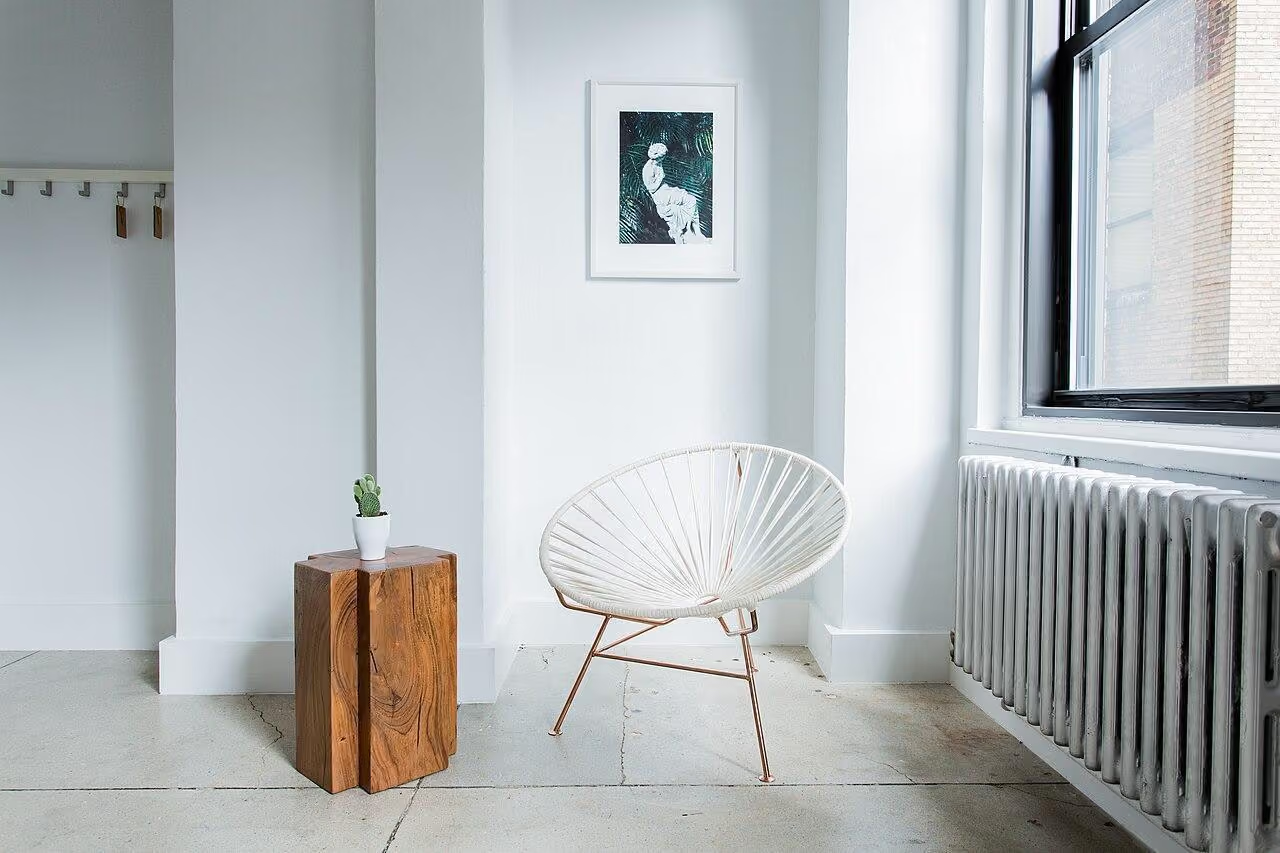
Heating and moisture deserve equal attention. A radiator under the sill cannot simply be enclosed without considering its requirements. A cold recess may also show condensation that needs investigation and suitable ventilation. Consult the relevant professionals where services or the building fabric are involved. The practical alternative may be a removable bench that leaves access around it, or an ordinary chair placed near the window rather than inside the recess. Giving up fitted storage is worthwhile if it preserves a healthy, usable window zone.
A radiator beneath the recess changes the seat's technical brief and should be assessed before enclosure. Designing around a Radiator without Pretending It Is Not There.
Choose a sitting posture before choosing upholstery
Decide whether the seat is intended for upright reading, occasional perching or curling up with the feet raised. Each asks something different of the cushion and back support. A thin decorative pad may look precise but feel hard after a short time. A very soft deep cushion can make standing awkward and reduce the useful seat area. Test the complete arrangement, including any loose back cushions, before asking an upholsterer or joiner to finalize the dimensions.
Removable covers are useful because this is a high-touch, sun-exposed position. Check the exact fabric’s care instructions and suitability for the light conditions. Pale chalk pink can be beautiful beside warm oak, but the color alone says nothing about fading or cleaning. A cover that can be removed is only convenient if it can also be refitted without a struggle. Keep the number of loose cushions modest so the seat remains available rather than requiring a small unpacking ritual every time someone wants to sit.
Storage beneath the seat is a separate design decision
Under-seat storage is often presented as free space. In practice, it has an operation that may be inconvenient. A lift-up lid requires the cushion to move, needs safe hardware and must remain controllable while open. Drawers need clear space in front and may conflict with a rug or nearby table. Open cubbies are easy to reach but keep their contents visible and can collect dust. Choose the mechanism around the objects stored, not around the cleanest cabinet elevation.
Daily books, a blanket and occasional seasonal objects need different access. Frequently used items should not require dismantling the seat. Heavy objects should not be stored where retrieval is awkward. Leave room for cleaning and any required inspection of the window or heater. Sometimes a plain removable bench plus one nearby basket is a more useful arrangement than elaborate built-in storage. The simpler version also makes it easier to change the room later if the seat turns out to be less popular than expected.
Dining benches pose a similar question: under-seat storage is useful only when its operation works. A Banquette That Is Comfortable after the First Ten Minutes.
Add the small things that let someone stay
A reader needs more than daylight. A local lamp becomes useful as the afternoon fades, and its cord must have a safe route. Position the light so the reader does not shade the page with their head or shoulder. A small stable side surface gives a cup and glasses somewhere to land. Avoid relying on the sill if it must remain clear for condensation management, plant care or window operation.
Consider privacy as well as the view. A ground-floor recess may feel exposed when the room is lit at night. A suitable window treatment should preserve the option of sitting there after dark without turning the person into a display. The surrounding room can remain visually quiet: a warm neutral wall, an oak line and a washable rose cushion may be enough. The seat’s main ornament is the changing light. Additional objects should not occupy the space the person needs to use comfortably.
Decide whether fitted construction earns its cost
Fitted joinery can use an irregular recess precisely and make the seat feel architectural. It also brings measuring, fabrication, installation and future repair obligations. A portable bench is less exact but easier to replace, move and clean around. Compare the complete cost and the quality of the sitting experience, not simply the amount of storage advertised. If the temporary trial does not produce a place people choose willingly, a more expensive version is unlikely to fix the underlying problem.
Before approving the final detail, check comfort, safe access, window operation, heating requirements, moisture conditions, light and storage use. Ask who will clean behind the bench and how a worn cushion will eventually be repaired or replaced. Those questions keep the detail useful beyond its first attractive week. The idea is unsuitable when a fixed seat compromises the window’s essential function or creates an unresolved environmental problem. An explicitly imagined scene offers the right final test: someone waits for a loved one to return, reading while the street changes beyond the glass. They are comfortable enough to forget the furniture. That ordinary ease, rather than a perfect cushion arrangement, is what makes the recess a second living room.
Check, record, then decide.
A proposed worksheet for your own observations. Use consistent units for dimensions and keep the conditions with each record.
Actual sitting experience
Where to check On a stable temporary bench within the intended window recess.
- Record
- Record seat and sill dimensions with units, the cushion used, reading posture, view and any discomfort during a normal session.
- Read the result
- A recess is worth fitting only if its posture and outlook are comfortable for the intended users.
- If it does not work
- Place an ordinary suitable chair beside the window rather than forcing a built-in seat.
Window and heating access
Where to check At handles, opening sashes, curtain stacks and any heating equipment below the sill.
- Record
- Draw their movement and service locations; note conflicts with the proposed bench and collect the relevant equipment instructions without inventing clearances.
- Read the result
- Fixed seating must not remove essential operation, ventilation or maintenance access to gain storage volume.
- If it does not work
- Use a removable bench or obtain an appropriately resolved technical design before proceeding.
Storage operation
Where to check In front of proposed drawers or above a proposed lift-up seat lid.
- Record
- List intended contents and retrieval frequency; record the space used by an open drawer or lid, moving cushion and nearby table.
- Read the result
- Storage that requires dismantling the seat may suit occasional belongings better than daily reading essentials.
- If it does not work
- Simplify the bench and place current items in an accessible nearby cabinet or basket.
A practical trial
- Read at the temporary seat at the intended hour and check standing, feet and a stable drink location.
- Operate the window and complete a representative cleaning movement without shifting heavy furniture or blocking a required opening.
- Trial the exact cushion-cover removal and storage access sequence before approving joinery and upholstery dimensions.
Compare the same scope
- Removable bench with separate everyday storage
- Fitted drawers with usable opening clearance
- Lift-up storage with suitable hardware and cushion handling
Cost drivers to discuss: Recess accuracy and bespoke joinery complexity; Upholstery, removable covers and replacement options; Heating, moisture or window-access work needing resolution.
Choose another route when: A fixed seat is unsuitable where the window's essential function or an unresolved heating or moisture condition cannot be preserved.
The download is a blank record template. Your completed notes remain wherever you choose to keep them; this page has no measurement-submission service.
Sources for this guide
Each reference’s supported point and limits appear beside the relevant passage above. Product documentation applies to the named product, rather than every similar item or the photographed room.
Source text checked November 4, 2026. Specifications can change; confirm the current instructions for the exact item before ordering.
Your questions, considered.
How do I know whether a recess will be comfortable?
Sit there on a stable temporary bench at the intended time of use. Check the view, feet, back support, draughts and ease of standing with the actual cushions included.
Can a window seat cover a radiator?
Do not assume so. Heating requirements, airflow, access and suitable materials need competent assessment. A removable bench or a nearby chair may be preferable when the service cannot be integrated appropriately.
Are drawers better than lift-up storage?
Drawers can make daily retrieval easier if there is opening clearance. Lift-up storage may suit occasional items, but it requires moving cushions and safely operating the lid. Choose by contents and frequency of access.
About this guide: written with AI assistance for TIANLICHUJU. These are general design ideas, not a measured survey or a completed client project. Any domestic vignette is fictional. Confirm product specifications, site dimensions and local requirements before construction; use qualified professionals for regulated work. Read our editorial approach or suggest a correction.